Write one for loop to print out each element of the list several_things. Then, write another for loop to print out the TYPE of each element of the list several_things. To complete this problem you should have written two different for loops, each of which iterates over the list several_things, but each of those 2 for loops should have a different result.
Write a program that uses the turtle module and a for loop to draw something. It doesn’t have to be complicated, but draw something different than we have done in the past. (Hint: if you are drawing something complicated, it could get tedious to watch it draw over and over. Try setting .speed(10) for the turtle to draw fast, or .speed(0) for it to draw super fast with no animation.)
Write code to count the number of characters in original_str using the accumulation pattern and assign the answer to a variable num_chars. Do NOT use the len function to solve the problem (if you use it while you are working on this problem, comment it out afterward!)
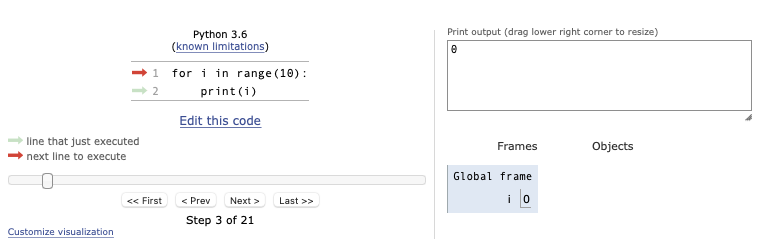
Not quite, The next line to execute is at the top of the for loop, not the print
The variable i checks for the end of the loop
Correct! The code needs to check the list and see if there is anything left to do (line 1). Once it realizes it still has numbers to process, the loop continues.
An error is thrown
Not quite, this code runs properly, try it yourself.